
D.R.I.V.E.
INdigenous Games Design
Seek. Create. Empower. Tell Our Stories. Build Our Future.
Mission
The D.R.I.V.E. INdigenous Games Design Program empowers Indigenous and local creators to preserve culture, inspire innovation, and build sustainable careers through tabletop games, video games, role-playing games, interactive storytelling, and emerging technologies.
Learners come to understand that games are more than entertainment. They are instruments of education, language revitalization, cultural preservation, diplomacy, workforce development, and economic opportunity — and, in the wrong hands, of erasure. Every project is guided by cultural respect, authentic community engagement, and responsible stewardship of Indigenous intellectual property.
Our Program Partner
Industry Support
D.R.I.V.E. INdigenous Games Design
Intentional design rooted in community need, cultural authenticity, and meaningful player experience.
- Game Design
- Systems Design
- Mechanics
- Worldbuilding
- Tabletop Design
- Video Game Design
- User Experience
- Educational Games
- Serious Games
- Cooperative Design
Every game begins with respectful research. Learners investigate history, language, oral traditions, environmental knowledge, contemporary issues, and community perspectives before creating anything.
- Indigenous Research Methods
- Oral History
- Cultural Consultation
- Historical Research
- Environmental Research
- Video Game Design
- User Experience
- Educational Games
- Serious Games
- Cooperative Design
Learners transform knowledge into interactive experience using contemporary creative tools while honoring traditional values.
- Digital Game Development
- Tabletop Publishing
- Artificial Intelligence
- Interactive Storytelling
- Virtual Reality
- Augmented Reality
- Animation
- Audio Production
- Accessibility
- Creative Technology
V — Visualize the Future
Learners explore the full range of careers within interactive entertainment — including the many roles that are not programming.
- Game Designer
- Narrative Designer
- Systems Designer
- Level Designer
- Producer
- Creative Director
- Artist
- Animator
- Technical Artist
- Sound Designer
- Composer
- Writer
- Programmer
- UX Designer
- QA Tester
- Publisher
- Studio Founder
- Cultural Consultant
- Localization Specialist
- Community Manager
Learners gain the technical and business skills needed to build, publish, and sustain a professional creative career.
- Programming
- Game Engines
- Artificial Intelligence
- Database Design
- Version Control
- Networking
- Publishing Pipelines
- Entrepreneurship
- Studio Management
- Business Development
Program Tracks
Games developed from moʻolelo, oral traditions, legends, history, cultural practices, language, environmental stewardship, and contemporary Indigenous experience.
Board games, card games, educational games, party games, miniatures games, and role-playing games — the fastest route from idea to playable prototype, and the lowest-cost route to publication.
Mobile, PC, console, and browser games, educational software, and interactive experiences.
Fictional worlds, historical simulations, interactive narratives, character development, adventure design, and campaign writing.
Working with cultural practitioners, respecting community protocol, protecting traditional knowledge, practicing ethical consultation, preserving language, maintaining Indigenous data sovereignty, and protecting intellectual property.
Launching studios, publishing games, building intellectual property, licensing products, crowdfunding, pitching investors, and building sustainable businesses.
Image Gallery Here
Track Record
-Chaos Kōnane.
Developed and hosted with KMKK’s Nā Mea Hoʻohui at Kamaʻāina Sunday — a variant of the traditional Hawaiian game kōnane played with non-uniform black and white construction pieces rather than uniform ʻiliʻili. Understanding a traditional game well enough to vary it deliberately is the discipline this program teaches, demonstrated in public.
-The Hawaiʻi tabletop community.
Since KMKK’s founding, the program has supported Hawaiʻi’s tabletop community by hosting Tabletop at the annual Kawaii Kon and at the biannual Table Oʻahu. This is service to an existing community rather than recruitment from it, and it rests on standing the founder already holds in it — Kumu Hobbs has held senior leadership roles at Hawaiʻi tabletop and convention organizations. It is also where the program’s own designers meet the players who will test their work.
Learning Outcomes
Program Philosophy
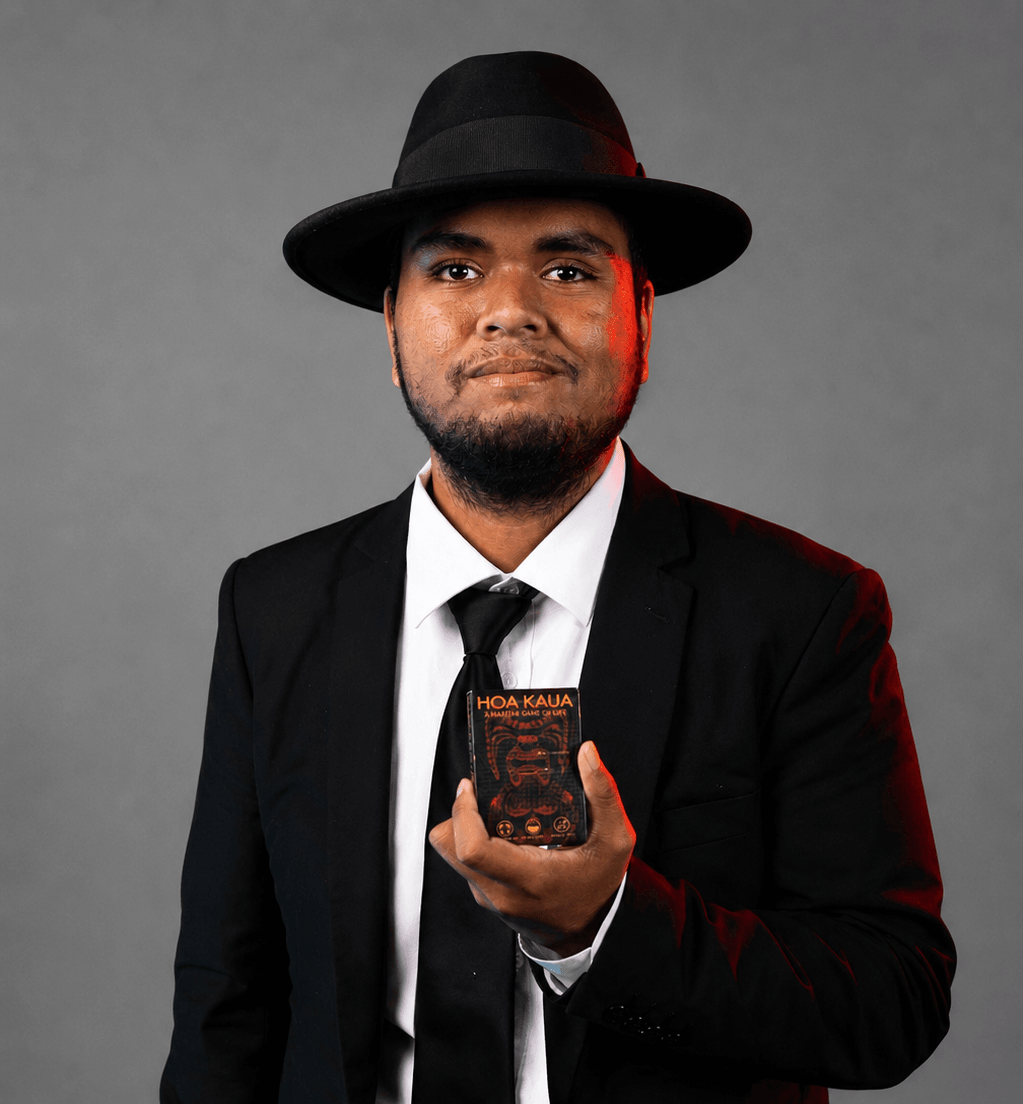
Jack Hobbs IV
Jack K. Hobbs IV is a 23-year-old Hawaiʻi-based game designer, educator, community organizer, and tabletop game professional whose work bridges game development, Indigenous storytelling, youth mentorship, cultural education, and community-centered creative technology. He serves as Chief Operating Officer of Project K4, a QBIPOC educational organization based in Hawaiʻi, and is the founder of INdigenous Games Design, a Project K4 D.R.I.V.E. program licensed to Ka Makani Kāʻili Koa’s Under the Helmet STREAMY initiative.
Raised in Nānākuli and active in Hawaiʻi’s game-development community since age 16, Hobbs brings approximately seven years of experience in game design, development, and gaming community leadership. His journey began as a student at Nānākuli High School, where he was introduced to game design through community-based educational programming. Since then, he has grown from student designer to instructor, advisor, program founder, convention leader, professional Dungeon Master, and game-industry advocate.
Hobbs is also a Co-Owner of Theorycraftist Games, a Hawaiʻi-based game company rooted in the belief that games can teach systems thinking, culture, social change, creativity, and collaboration. In his capacity as a game designer with Theorycraftist, he has co-developed a diverse portfolio of tabletop and interactive game concepts, including Hō‘akaua, a competitive card game inspired by the wars, warriors, and martial traditions of ancient Hawaiʻi; The Depression Game, a social deduction game in which players take on the roles of high school students navigating the daily realities of depression; The Nānākuli Esoteric Order of Investigators, a mystery and time-travel game originally envisioned as an augmented-reality experience where students move back and forth through time to solve mysteries connected to Nānākuli High School; and Namja Myeon, a playful restaurant strategy game in which one player serves as the cook while others play as devoted fans, competing to build the most successful restaurant in town through K-pop-inspired humor, food culture, and themed ingredients.
Across these projects, Hobbs’ design work demonstrates a broad creative range: culturally rooted competitive systems, socially conscious educational games, mystery-driven narrative design, augmented-reality concepts, comedy-based tabletop mechanics, and youth-centered interactive storytelling. His work reflects a commitment to designing games that are not only entertaining but also capable of opening conversations about identity, history, mental health, community, and imagination.
As founder of INdigenous Games Design, Hobbs champions tabletop games, digital games, roleplaying systems, worldbuilding, and interactive storytelling as tools for cultural education, leadership development, and creative career pathways. His approach centers Indigenous perspectives, local youth, and community knowledge, helping students understand that games are not only entertainment but also systems of learning, identity, strategy, and imagination.
Hobbs has been involved in Hawaiʻi’s gaming and convention ecosystem for nearly a decade. At age 18, he began teaching game design nationally and entered senior leadership roles with both Kawaii Kon and TableTop Con, giving him approximately five years of experience as a game-design educator and convention leader. By age 20, he was serving as an advisor and professional Dungeon Master, bringing approximately three years of experience in advanced mentorship, tabletop facilitation, campaign design, and collaborative storytelling.
Beyond the game industry, Hobbs has held leadership and service roles across Native Hawaiian, youth, civic, and charitable programs. He previously served as an officer of Nā Koa O Ka Mōʻī, also known as The King’s Guard, under Ka Makani Kāʻili Koa’s Nā Koa Hawaiʻi programs, and serves as a Unit Commander supporting Shriners Children’s community service activities. These experiences continue to inform his leadership style: disciplined, youth-centered, culturally responsible, and rooted in service.
Currently pursuing a degree in Game Development, Hobbs represents a rising generation of Hawaiʻi-based game creators building pathways for Indigenous, local, QBIPOC, and underrepresented students in the global games industry. His long-term vision is to expand Hawaiʻi’s presence in game development by creating programs, games, and educational models that prepare students not only to play in imagined worlds but to design, lead, and own them.
Hobbs welcomes scholarship, mentorship, publishing, industry, and educational partnership opportunities that support his continued development as a game designer, educator, and cultural technology leader.